


TEDx Little Armenia did not ask its audience to choose between identities.
It asked them to hold more than one at once.
The inaugural event—created through a landmark partnership between the USC Institute of Armenian Studies, TEDx, and TEDxYerevan—marked the first TEDx program of its kind to center Little Armenia as both a local community and a global intellectual space. Organizers described the collaboration as a deliberate bridge between diaspora and homeland, signaling that Armenian stories, ideas, and innovation do not flow in one direction but move across borders, generations, and lived realities.
“This is about claiming space,” said Dr. Shushan Karapetian from the stage. “Not waiting to be invited into global conversations, but building platforms where our complexity, our multiplicity, and our voices are the starting point—not the exception.”
The inaugural event, recognized as the first Tedx license specifically dedicated to a diaspora community through a partnership with Tedx Yerevan, brought together scholars, artists, technologists, educators, and storytellers to explore what it means to live—and create—at the intersection of cultures, disciplines, and histories.
Hosted in Los Angeles, home to one of the largest Armenian diasporas in the world, the event positioned Little Armenia as a generative center of ideas—one in active dialogue with Yerevan and the wider global Armenian experience. The theme, Hybrid Identities, felt less like an academic framework and more like a lived truth echoed across every talk.
From the opening remarks, the message was clear: Tedx Littlle Armenia is “a space to explore how multiple identities can coexist within one person, and how those layers, when embraced, become a source of creativity, resilience, and innovation. It is a celebration of a dynamic community whose strength comes not from uniformity or homogeneity, but from diversity and heterogeneity” said Dr. Karapetian, Director of the USC Dornsife Institute of Armenian Studies.
The audience itself reflected that vision. Students sat beside civic leaders. Artists beside engineers. Immigrants beside those born into diaspora. What followed was a conversation about how we enter spaces, how we design futures, how we practice care, and how communities carry us forward when institutions do not.
Again and again, speakers returned to a shared truth: identity does not need permission to exist. It emerges when space is made for it.
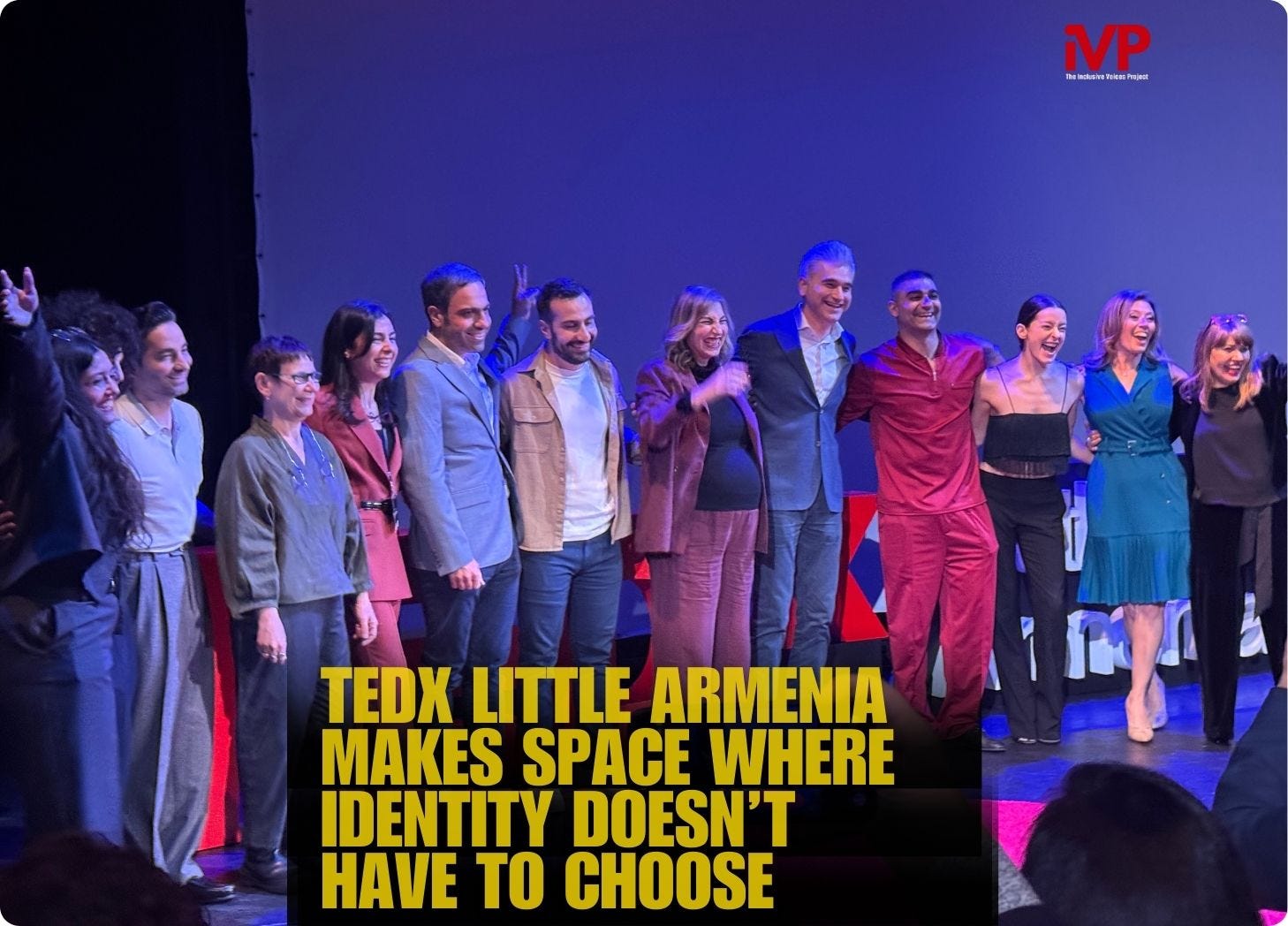
Speaker Highlights
Ani Adjemian
Lecturer in Law at USC Gould School of Law
Talk focus: The Power of Greeting and Belonging
Adjemian opened the program by examining how something as simple as a greeting can shape identity, safety, and belonging. Drawing from neuroscience, anthropology, and personal history, she traced how a single word – barev – became a posture for how she moves through the world. Her talk argued that belonging often begins not with credentials or status, but with intention. How we enter a room, she suggested, can quietly alter the course of a life.
Ashot Arzumanyan
Partner at SmartGateVC
Talk focus: Exponential Growth and Finding Your Superpower
A venture capitalist working at the frontier of deep tech, Arzumanyan translated startup logic into a framework for personal growth. His central idea: we systematically underestimate exponential change, even as the world accelerates around us. Success, he argued, comes from identifying your unique strength and placing it ahead of an emerging wave. His takeaway was practical and introspective—growth is not optional, but direction is a choice.
Aroussiak Gabrielian
Founding Design Principal of Foreground Design Agency
Talk focus: Designing With, Not Against, Living Systems
Designer and scholar Gabrielian challenged the audience to rethink how humans relate to land, bodies, and mortality. Using rivers, soil, breath, and decay as design systems, she argued that modern design fails when it treats life as static. Her work reframed sustainability not as preservation, but as participation—asking how humans might ethically design for transformation, including our own eventual return to the earth.
Karen Khachikyan
Co-Founder and CEO of Robin the Robot
Talk focus: Kindness As a Practiced Skill
Khachikyian, founder of a healthcare robotics company, shared how building an emotionally intelligent robot forced him to confront his own assumptions about kindness. Watching a robot model attentive presence revealed how often humans default to distraction. His talk reframed kindness not as an inherent trait, but as a discipline—one that requires discomfort, patience, and practice.
Ludvig Ispiryan
Dancer, Choreographer, and Artist Director of The Grand Academy of Ballet
Talk focus: Performance
Midway through the program, the evening shifted from words to movement. A solo dance performance—rooted in Armenian folk traditions while shaped by contemporary form—translated the theme of hybrid identity into the body itself. Trained in both classical and modern disciplines, the dancers moved between restraint and release, control and vulnerability, embodying the tension many speakers had articulated in language. The performance required no translation. It offered a reminder that identity is not only spoken or theorized, but carried through muscle memory, breath, and motion across generations and geographies. In a room filled with thinkers and storytellers, the dance stood as its own argument: that some truths about belonging are felt long before they are named.
Marie Lue Papazian
Founding CEO of TUMO Center for Creative Technologies
Talk focus: Creating Conditions for Identity to Emerge
The founder of the TUMO Center for Creative Technologies reflected on education, motherhood, and diaspora. Papazian described identity not as inherited or imposed, but as something that emerges when young people are given freedom, choice, and space to connect ideas. TUMO, she argued, works because it creates conditions where new selves can form.
Armen Derkevorkian
Co-founder and President at Signal7
Talk focus: Refusing to Choose Between Disciplines
A scientist, violinist, and tech founder, Derkevorkian traced a life spent being asked to pick one identity over another. His talk rejected that premise entirely. Rather than dividing himself, he learned to let multiple disciplines inform one another. The result, he said, was not confusion—but leadership. Hybridity, in his telling, is not a liability. It is leverage.
Sev Ohanian
Screenwriter, Producer & Founder of Proximity Media
Talk focus: Community as Creative Infrastructure
Closing the evening, Ohanian reflected on risk, storytelling, and the myth of having “nothing.” Recounting his early filmmaking years within the Armenian community, he argued that what he once believed were limitations—lack of access, resources, representation—were in fact the foundation that made his work possible. His message resonated beyond filmmaking: when marginalized communities succeed, they do not rise alone. They lift belief itself.
A Space Claimed, Not Granted
TEDxLittle Armenia created its own platform.
In a media landscape that often flattens identity or treats diaspora as an afterthought, the event insisted on complexity. It centered voices that live between worlds and showed that hybridity is not something to resolve—but something to cultivate.
For The Inclusive Voices Project, the night offered a living example of its mission: when people are seen, when space is intentionally built, voices do not need to be amplified—they rise on their own.


